From WCS to PWCS: Understanding the Title Change in Board-Certified Pelvic & Women’s Health Physical
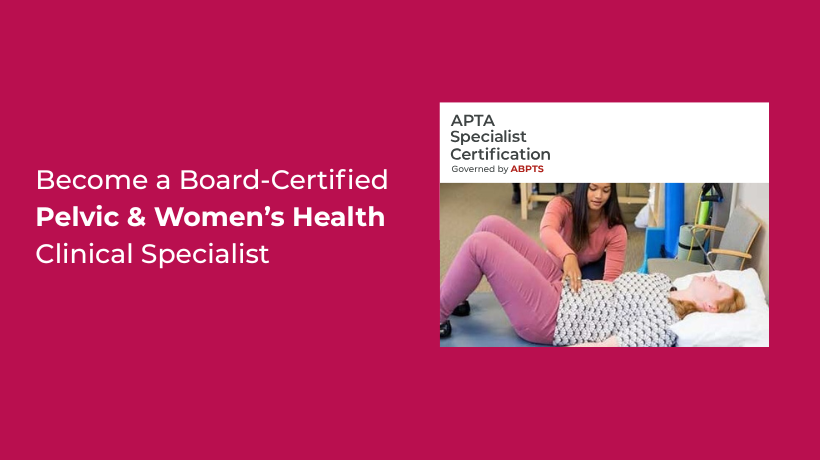
In September 2025, the Women’s Health specialty officially transitioned to Pelvic and Women’s Health following approval by the American Board of Physical Therapy Specialties (ABPTS) and approval via the APTA House of Delegates. As a result, credentialed specialists who have previously used the WCS designation or Board-Certified Women’s Health Clinical Specialist may now switch to using the PWCS designation or spell out the credential as Board-Certified Pelvic and Women’s Health Clinical Specialist.
The rigor, eligibility requirements, competencies, and expectations of board certification remain unchanged. What has changed is the title, updated to more accurately reflect contemporary clinical practice and the populations served by specialists in this field.
Governance and Oversight: Clarifying Roles
It is important to clarify that the Academy of Pelvic Health Physical Therapy does not direct, oversee, or govern the PWCS (former WCS) credential. Oversight of board certification resides solely with ABPTS, under the broader structure of the American Physical Therapy Association (APTA). The Academy is a component of the American Physical Therapy Association.
The Pelvic and Women’s Health Specialty Panel (formerly the Women’s Health Specialty Council), operating under ABPTS, facilitated the name change following multi-year discussions among several annually rotating specialty councils, with the 2025 council finally moving the proposal forward. As part of ABPTS and APTA’s standard review process, stakeholder organizations—including the Academy of Pelvic Health Physical Therapy—were solicited for feedback prior to this change being presented at the APTA House of Delegates by APTA. While the Academy provided input, it did not author, control, or make any final decisions related to the WCS.
Why the Name Changed
The proposal to move from Women’s Health Certified Specialist (WCS) to Pelvic and Women’s Health Certified Specialist (PWCS) was grounded in three core considerations:
1. Broader Representation of Scope of Practice
The addition of the word “Pelvic” acknowledges that board-certified specialists treat a wide range of pelvic health conditions across all populations and across the lifespan. This includes care for pediatric patients, men, and individuals undergoing gender-affirming care. While the specialty originated within women’s health, pelvic health practice has long extended beyond a single population, and the updated title reflects that reality more precisely.
2. Preserving and Honoring Women’s Health
Retaining “Women’s Health” in the title was intentional and essential. The specialty was established to address significant healthcare disparities affecting women—disparities that persist today. Board-certified specialists continue to provide comprehensive care across the female lifespan, including puberty, pregnancy, postpartum recovery, menopause, hormonal-influenced cancers, osteoporosis, and other sex-specific and hormonally-mediated conditions. The updated title honors both the origins and the continued central role of women’s health within the specialty.
3. Language Alignment
The term “pelvic health” aligns with the language commonly used in clinical settings, where many practitioners already identify as pelvic health or pelvic floor physical therapists.
What This Change Does—and Does Not—Mean
This title change is best understood as a clarification, not a redefinition. It does not alter:
-
Board certification eligibility requirements
-
Examination content or competency domains
-
Professional standards or scope of practice
Instead, it ensures that the name of the credential accurately communicates the expertise of board-certified specialists to patients, employers, policymakers, and the broader healthcare community.
How to Correctly List Your Designation
If you have become a Board-Certified Clinical Specialist, please make sure that your designation is compliant with ABPTS designation listing rules and is correctly displayed on your profile, business cards, websites, etc.
Acceptable Example 1:
Joanna Doe, PT, DPT
Board-Certified Clinical Specialist in Pelvic and Women’s Health Physical Therapy
Acceptable Example 2:
Joanna Doe, PT, DPT
Board-Certified Pelvic and Women's Health Clinical Specialist
Acceptable Example 3:
Joanna Doe, PT, DPT, PWCS
Looking Ahead
Language matters—particularly in healthcare specialties that continue to evolve in response to clinical evidence, patient needs, and professional growth. The transition from WCS to PWCS reflects where the specialty is today, while preserving the history and purpose that led to its establishment.
As always, the Academy of Pelvic Health Physical Therapy remains committed to supporting education, professional development, and advocacy for pelvic and abdominal health physical therapy at every life stage—while respecting the distinct governance role of ABPTS in specialty certification.
Over the coming weeks, the Academy of Pelvic Health Physical Therapy will be gradually updating its website to ensure the new credential is correctly reflected.
FAQs
Not sure of the answers to these questions.
-
Has the application criteria changed? No, the application criteria has not changed.
-
I am currently studying for the PWCS. Will the exam content change? When will it change? What content changes are expected in the future? The exam content currently includes content reflected in the current description of specialty practice (https://specialization.apta.org/become-a-specialist/womens-health/dsp) and does include content related to male pelvic health, pediatric pelvic health, female pelvic health, and women's health topics. Any changes to exam content occur following a revalidation study of the Description of Specialty Practice by a diverse task force, which is a four-year process that should be completed around 2029. All information regarding exam content, questions, etc can be accessed at ABPTS: https://specialization.apta.org/become-a-specialist/womens-health
Inquiries
If you have any questions about the PWCS, please visit the ABPTS website at https://specialization.apta.org/become-a-specialist/womens-health.
